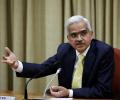
The Reserve Bank remains laser-focused to bring back retail inflation to 4 per cent over a period of time in a non-disruptive manner, Governor Shaktikanta Das stressed while voting for status quo in interest rates, as per minutes of the October policy meeting released on Friday. The central bank has been mandated by the government to ensure the Consumer Price Index (CPI) based inflation is at 4 per cent, with a band of 2 per cent on either side. The retail inflation, which was above 6 per cent during May and June, has started moving down and stood at 4.35 per cent in September.
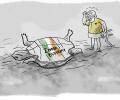
S&P Global Ratings on Wednesday cut India's growth projection for the current fiscal to 7.3 per cent from 7.8 per cent earlier on rising inflation and the longer-than-expected Russia-Ukraine conflict. In its Global Macro Update to Growth Forecasts, S&P said inflation remaining higher for long is a worry, which requires central banks to raise rates more than what is currently priced in, risking a harder landing, including a larger hit to output and employment. S&P had in December last year pegged India's GDP growth in the 2022-23 fiscal, which began on April 1, 2022, at 7.8 per cent.

Equity markets would take cues from domestic inflation data announcement, global trends and trading activity of foreign investors in a holiday-shortened week ahead, analysts said. Markets would remain closed on Tuesday for 'Diwali Balipratipada'. "As we enter a truncated week with Muhurat trading on Sunday, global cues will play a pivotal role in shaping the market direction.

The rate of price rise for consumer foods eased to 4.7 per cent in January, from 4.96 per cent in December.

The mismatch between industrialists' demand and account holders is because of inflation, Rajan said.

While achieving an eight per cent retail inflation rate by January 2015 is well within reach, Reserve Bank of India Governor Raghuram Rajan notes there is a second target, of six per cent by 2016.
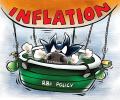
The Consumer Price Index (CPI)-based inflation is now projected to be at 5.3 per cent for 2021-22 with risks evenly balanced. In its August policy, the central bank had estimated inflation to be at 5.7 per cent due to supply side constraints, high crude oil and raw materials cost.

A collapse in global oil prices has unleashed a wave of monetary easing.

The RBI has set up a panel to review ATM charges, and fees levied by banks.

Finance Minister Nirmala Sitharaman on Wednesday said the country's economic growth remains a priority for the government, as inflation has come down to a manageable level. Job creation and equitable distribution of wealth remain the other focus areas, she said at India Ideas Summit. "Some of course are red-lettered (priorities), some may not be. Red-lettered ones would of course be jobs, equitable wealth distribution and making sure India is moving on the path of growth.

'I wonder if they will keep it up after the elections.' 'I fear they'll start questioning eligibility -- income, age, bank accounts -- and eventually stop the scheme altogether.'

Inflation in pulses, vegetables and cereals was higher in Jan.

"The main risk stems from the uncertainty surrounding the outcome of the south west monsoon in view of the rising probability of an El Nio event around July-August, and its implications for food inflation," RBI said, as it kept the status quo on key interest rate for the third time in a row.

Union Finance Minister Nirmala Sitharaman's call for making lending rates affordable may not resonate anytime soon as banks still struggle with margin compression, and await clues from the Reserve Bank of India (RBI) on liquidity and rate action. Hinting that any lending rate cut was some time away, State Bank of India (SBI) managing director Vinay M Tonse said there was still some aggression in the market regarding deposit pricing.

At over 6 per cent, most states in October had inflation rates above the Reserve Bank of India's target band of 2-6 per cent.

"I don't think that it is government's view that the present inflation cannot be brought under control without FDI in multi-brand retail. We can bring inflation under control," Planning Commission Deputy Chairman Montek Singh Ahluwalia said.

Marico may buck the industry trend with the fast-moving consumer goods (FMCG) major reporting strong growth and favourable commentary in a weak quarter for the industry. The company reported consolidated revenue growth of 8 per cent year-on-year (Y-o-Y) in Q2FY25. Domestic revenue growth was 8 per cent Y-o-Y with 5 per cent volume growth (4 per cent in Q1FY25).

Wholesale price inflation stood at 4.78 per cent in November. The consumer price index for agricultural labourer and rural labourers were 13.73 per cent and 13.51 per cent in October.

From the Sensex pack, Bharti Airtel, Titan, Tata Consultancy Services, Hindustan Unilever, Infosys, Nestle, Reliance Industries, Mahindra & Mahindra, HDFC Bank and Tata Motors were the biggest gainers. However, IndusInd Bank, Bajaj Finance and UltraTech Cement were the laggards.

The Indian economy is recovering from the slowdown in momentum witnessed in the September quarter, driven by strong festival activity and a sustained upswing in rural demand, according to a Reserve Bank of India (RBI) bulletin released on Tuesday. An article on the 'State of the Economy' in the December bulletin noted that the global economy continues to exhibit resilience with steady growth and moderating inflation.

The FMCG industry hopes for a revival in consumption growth in 2025 with some 'green shoots' already visible, after having a challenging year amid escalating input costs and a double-digit rise in food inflation, which ultimately slowed down the pace of the urban market growth in the second half of 2024. Soaring prices of commodities such as palm oil, coffee, cocoa and wheat forced FMCG players to go for a hike of 3 to 5 per cent or resort to shrinkflation by reducing pack sizes and grammage to retain attractive price points, fearing a volume loss.

Wholesale inflation shot up to a 30-month high of 5.25 per cent in January as rising global crude oil prices spiked domestic fuel cost, even as food prices moderated.

The wholesale price-based inflation rose for the second consecutive month in February to 4.17 per cent, as food, fuel and power prices spiked. The WPI inflation was 2.03 per cent in January and 2.26 per cent in February last year. After witnessing months of softening of prices, the food articles in February saw 1.36 per cent inflation. In January it was (-) 2.80 per cent.
Indian stock markets are expected to be driven mostly by global factors this week amid a lack of local triggers and earnings season largely coming to an end, say analysts. Crude oil prices, rupee movement and US Federal Reserve meeting minutes to be released this week will also influence the market sentiment. "With the earnings season behind us, global cues would largely dictate the trend in the coming week," Ajit Mishra, SVP - technical research, Religare Broking Ltd, said.

For August, CRISIL core inflation indicator stood at 3.6 per cent, a tad higher than RBI's measure.
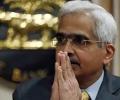
Reserve Bank Governor Shaktikanta Das on Friday stressed that the monetary policy must remain actively disinflationary to ensure that the decline in inflation from its peak of 7.44 per cent in July continues smoothly. Addressing the Kautilya Economic Conclave 2023, he also said price stability and financial stability complement each other and it has been an endeavour at RBI to manage both efficiently. Retail inflation declined to a three-month low of 5.02 per cent annually in September on account of moderation in vegetables and fuel prices, and was back within the Reserve Bank's comfort level.

The March Wholesale Price Index-based inflation was at (-) 0.85 per cent.

Movement in the equity market this week will largely be dictated by quarterly earnings of blue-chip firms HDFC Bank and Hindustan Unilever, along with the announcement of WPI inflation data and global trends, analysts said. Trading activity of foreign investors, global oil benchmark Brent crude and rupee-dollar trend would also guide the movement.

The Reserve Bank's rate-setting panel will start its 3-day deliberations on Wednesday amid expectations of yet another rate hike of 50 basis points to check high inflation, in line with similar actions taken by other major central banks, including the US Fed. Based on the recommendations of the Monetary Policy Committee (MPC), the RBI had effected 50 basis points increase in repo rate each in June and August after raising the short-term lending rate by 40 basis points in an off-cycle decision in May. The MPC, headed by RBI Governor Shaktikanta Das, is scheduled to meet during September 28-30.

'The FY2023 inflation outcome is likely to exceed the RBI's current forecast by a wide margin.'

Finance Minister Nirmala Sitharaman on Thursday said India has ramped up the import of crude oil from Russia at discounted prices amid sanctions on Moscow as part of the country's inflation management. "In a situation where global prices were going beyond anyone's affordability, at that stage to take a very strong political decision, I respect the prime minister for his courage on this to get it from Russia because they are ready to give it to you at discount. And how speedily did we manage to do it," she said. India ramped up its import from Russia from about 2 per cent of the total shipment of petroleum products to 12-13 per cent in a couple of months as part of inflation management, she said at a seminar organised by economic think-tank Icrier.

The states that witnessed high CPI-based inflation rates were Lakshadweep, Tripura, Odisha, Uttar Pradesh, Kerala, Madhya Pradesh, Puducherry, Tamil Nadu, Rajasthan, Manipur and Mizoram.

Automobile retail sales in India rose by 9 per cent in August aided by sales growth in all segments, including passenger vehicles and two wheelers, dealers' body FADA said on Tuesday. The total retail sales across segments rose to 18,18,647 units last month, up 9 per cent, from 16,74,162 units in August 2022. Passenger vehicle registrations increased by 7 per cent to 315,153 units last month from 295,842 units in August 2022.

Prices of food articles contracted by 3.47 per cent in June on a yearly basis. Vegetable inflation stood at (-)21.16 per cent.

'The nominal GDP growth assumption for FY25 may be revised upwards on higher growth expectations.'

Wholesale price-based inflation eased to a nine-month low of 4.68 per cent in February, while retail inflation slowed to a 25-month low of 8.1 per cent.

While the economy seems to be on a firm growth path, the fight against inflation is not over yet. Shaktikanta Das seems to be in no hurry. After playing well through a five-year Test match, he doesn't want to get out hit wicket, observes Tamal Bandyopadhyay.

The recent equity market weakness has sobered up investor mood, but the coming festive season is keeping analysts upbeat on stocks related to the consumption basket. Among the lot, fast-moving consumer goods (FMCG), retail, and consumer electronics segments are expected to do well over the next few months, and investors should thus selectively take bets in these pockets, analysts suggest. "We expect good volume growth for the FMCG sector during the festive season with some improvement in rural demand.

Major Indian carmakers are preparing for sluggish domestic PV sales growth of just 1-2 per cent in FY26.
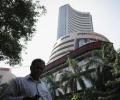
Among the Sensex firms, NTPC, Power Grid, Mahindra & Mahindra, Larsen & Toubro, Sun Pharma, State Bank of India, Titan and Tata Steel were the major gainers. Tata Consultancy Services, Infosys, Axis Bank, Bajaj Finserv, UltraTech Cement and Bajaj Finance were the major laggards.
